
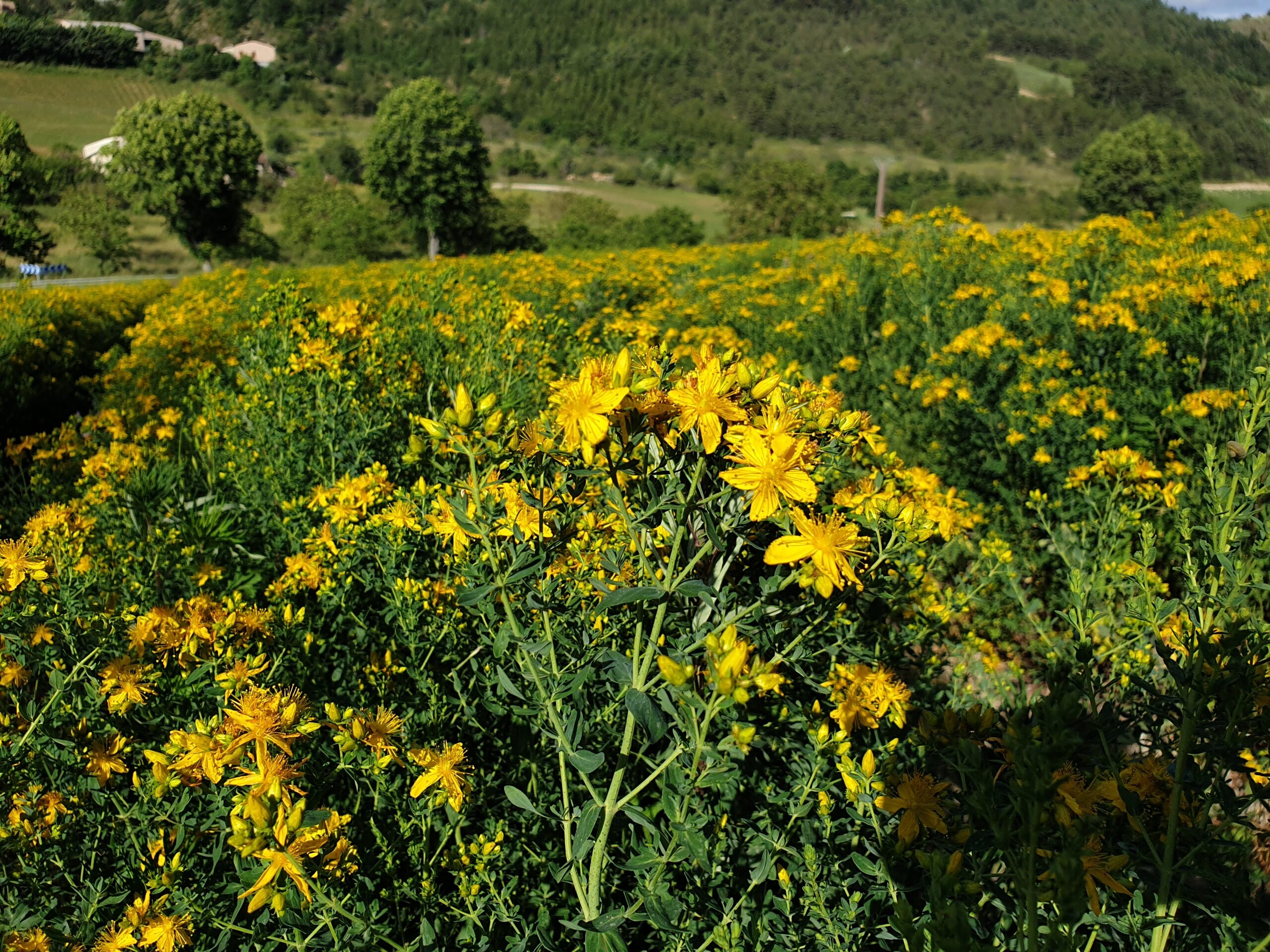
The St John's Wort season is finally here!
With 20 years' experience in the production of this macerate, we have chosen to perpetuate the traditional manufacture of this solar macerate in 20L glass demijohns. We produce between 10 and 20 tons of this macerate every year, which represents our biggest production and a major peak in workload, which our well-organized team knows how to manage brilliantly. The fact that our cultivation facilities are located close to the company also enables us to organize work along the entire chain, from harvesters to preparers, to guarantee the quality and freshness of the plants we use on a daily basis.

Our improvement since last year!
Summer thunderstorms are not uncommon due to the hot weather, and hail is a regular occurrence in our region. To protect our products, we have decided to install small-mesh transparent netting to provide optimum protection for our glass carboys, thus avoiding breakage and product loss.


How does St John's Wort work?
The action of St. John's wort seems to be linked to naphthodianthrones, such as hypericin and pseudohypericin, and phloroglucinols, such as hyperforin. Hypericin was long thought to be the active substance against depressive states. However, recent studies suggest that St. John's Wort's antidepressant effects are more closely linked to its hyperforin concentration.
The mechanism of action of St. John's Wort on mood remains poorly understood. Researchers have abandoned the hypothesis that, like some old antidepressants now abandoned, it inhibits the action of monoamine oxidase (MAO), an enzyme involved in brain biochemistry. Today, they are leaning towards a complex action of several substances present in St. John's Wort.
The action of St John's Wort on skin problems is linked to the antiseptic effect of naphthodianthrones.
How effective is St John's Wort?
One of the main effects of St John's Wort on depressive symptoms has been confirmed by over 30 placebo-controlled studies involving more than 4,000 patients. The results of these studies showed that St. John's wort extracts were as effective as depression medications (conventional synthetic antidepressants) in mild to moderate depressive states.
On the other hand, St John's Wort does not appear to be sufficiently effective in providing lasting relief from moderate to severe depression.
In these studies, the duration of treatment was four to eight weeks. These were temporary depressive episodes, not long-lasting depression.
The results of these clinical studies were sufficiently convincing for the health authorities in several countries, including France, to recognize St. John's wort-based products as medicines for the treatment of mild to moderate transient depression.
St. John's Wort is the only plant recognized for use in this indication.

But also...
St John's Wort oily macerate is traditionally used to relieve all kinds of burns, including sunburn.
On burned skin, it is particularly interesting thanks to its soothing and regenerating properties.
These actions promote the production of deeper skin cells and accelerate the repair process of burnt skin.
In addition, it has natural analgesic and anti-inflammatory properties that help relieve distressed skin.
However, we strongly advise against using St. John's wort oily macerate followed by exposure to the sun, as it contains a molecule called hypericin, which is extremely phototoxic. It makes this oily macerate highly photosensitizing. It is therefore important to avoid exposure to the sun for at least 12 hours after applying St John's Wort oily macerate.